

First let us examine the salient features of a Shiv lingam. It’s made up of two parts. The first is a cylindrical structure made of polished stone. The second is the surrounding coils or grooves ending in a spout. In Shiv temples, a pot of water hangs over the cylindrical structure, allowing water to continuously drip on it at regular intervals. This water then empties itself out through the spout.
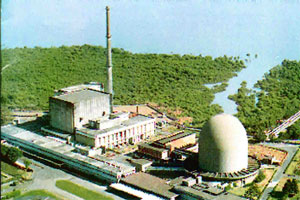
This is an aerial view of the Bhabha Atomic Research Centre-BARC on the outskirts of Mumbai. Notice the parallel between the two pictures?
We often forget to observe what is in plain sight! The cylindrical structure that you see in the picture of BARC is the core nuclear reactor. Its shape is identical to the cylindrical structure of the lingam. Like the cylinder of Shiv lingam, the nuclear reactor too needs a regular supply of water to cool it down as it heats up during the process of generating energy. Notice the coils around the main reactor? Those are structures built to dispose of the water-just like the coils around the lingam.
Think about it. It’s only in a Shiv temple that the water flowing from the lingam is not consumed as holy water. Why? The water from a Shiv lingam is not drunk for precisely the same reason as the water from a nuclear reactor is not potable-it is charged water. Why are most Shiv temples always found near a source of water, say a river or lake? That’s because Shiv lingam-just like modern-day reactor-need water for cooling the core. Do you know that no one is allowed to cross the spout of a Shiv lingam during pradakshina-the circumambulation of the lingam during worship? People have to turn back as soon as they approach the spout because the spout represents irradiated water.
What I’m trying to tell you is that the Shiv lingam is not a presentation of some god called Shiv. It’s an ancient symbol to represent a supreme force, an energy that our ancestors chose to call Shiv. This energy was the exact opposite of another energy form called Vish.
“Krishna was the eighth avatar of Vishnu-a manifestation of a form of energy that we shall call Vish. The exact opposite energy of Vish is Shiv. While Vish, creates and preserves, Shiv destroys.”
The people of the Sarasvati civilisation knew these forms of energy. Modern man prides himself on having discovered nuclear power. Little does he realise that far greater powers were available to society and civilisations during the Vedic age and the Mahabharata!
Oppenheimer, the father of the atom bomb, is said to have quoted the Bhagwad Gita after witnessing the first successful test of the bomb in 1945. His words? “I am become death, the destroyer of the worlds.” Oppenheimer had learned Sanskrit specifically with the intention of being able to understand the Gita. The passage in the Gita that says what Oppenheimer was quoting is: “I am become time to end the world, set on my course to destroy the universe.” The clues to an ancient nuclear age are right before us in the ancient Hindu scriptures.
 Vishrut Gajjar
Strong article! Good job!
LikeLiked by 1 person
Thank you😊
LikeLike